
Helensburgh Landcare Logo
+61 414 819 742
Helensburgh Landcare Logo
  • Home Home
  • Membership Membership
  • Be Weed Wise Be Weed Wise
    • Asparagus fern
    • Asthma weed
    • Black-eyed Susan
    • Blue periwinkle
    • Canna lily
    • Easter cassia
    • Cocos palm & Canary Island date palm
    • Dietes, Butterfly iris
    • English ivy
    • Formosan lily
    • Giant Bird of Paradise
    • Ginger lily
    • Japanese sacred bamboo
    • Liriope
    • Madeira vine
    • Montbretia
    • Moth vine
    • Mother of millions
    • Small leaf privet
  • Streamwatch Streamwatch
  • News and Updates News and Updates
  • Call Us +61 414 819 742 Call Us +61 414 819 742
Helensburgh Landcare Logo
+61 414 819 742
Helensburgh Landcare Logo
  • Home Home
  • Membership Membership
  • Be Weed Wise Be Weed Wise
    • Asparagus fern
    • Asthma weed
    • Black-eyed Susan
    • Blue periwinkle
    • Canna lily
    • Easter cassia
    • Cocos palm & Canary Island date palm
    • Dietes, Butterfly iris
    • English ivy
    • Formosan lily
    • Giant Bird of Paradise
    • Ginger lily
    • Japanese sacred bamboo
    • Liriope
    • Madeira vine
    • Montbretia
    • Moth vine
    • Mother of millions
    • Small leaf privet
  • Streamwatch Streamwatch
  • News and Updates News and Updates
  • Call Us +61 414 819 742 Call Us +61 414 819 742

Japanese sacred bamboo

Home/ Be Weed Wise/ Japanese sacred bamboo

Nandina domestica

Native to eastern Asia, Japanese sacred bamboo is considered an environmental weed in NSW. This species is currently of most concern in the wider Sydney and Blue Mountains region in central New South Wales. It is currently not very widespread or common, but its abundance and range is increasing. It is also an invasive weed in large parts of south-eastern USA where it is displacing native vegetation.

Sacred Bamboo is generally grown for its foliage which has colourful red and green leaves. Small, white flowers are followed by red berries in autumn. It was a popular planting around a certain takeaway at one time. Birds spread the berries into bushland, and that is when it becomes a problem. Many reports also suggest that the berries are toxic to a range of animals, including dogs, cats and cattle. It has been known to kill birds when they gorge on the berries.

Control: remove and bag the berries and place them in your red bin. The whole plant can then be dug out and placed in the green bin.
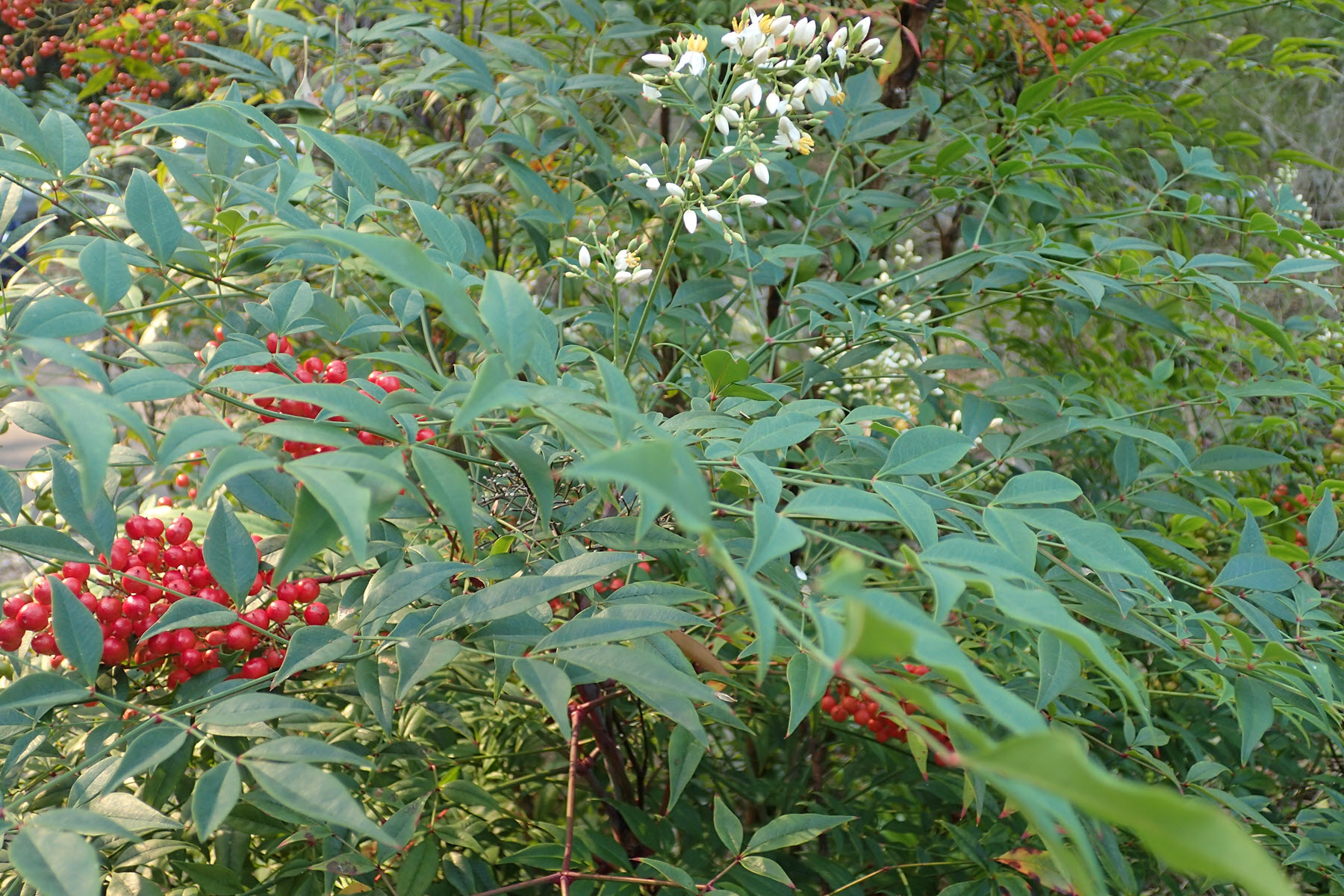
Nandina Flowers & Fruit

Grow Me Instead

Honey myrtle Melaleuca linariifolia ‘Little Red’
A dense compact shrub with small leaves and bright red new growth throughout the warmer months.


Dwarf willow peppermint Agonis flexuosa ‘Nana'

A highly attractive, compact, evergreen shrub that produces willow-like foliage with red new growth and small white flowers in Spring.

25 Tunnel Road, Helensburgh,
NSW 2508 Australia

 merilyn@helensburghlandcare.org.au

 0414 819 742

Stay Connected

Helensburgh & District Landcare Group acknowledges the traditional custodians of the land. We pay respect to Aboriginal Elders past, present and emerging, and extend that respect to other First Nations people. We value their deep and continued spiritual and cultural connections to the land, waters and seas.

Helensburgh & District Landcare Group Inc is a non-governmental community movement dedicated to preventing land degradation and achieving sustainable land management, primarily in the 2508 postcode.

ABN: 12 869 870 867

https://landcareaustralia.org.au

Our site is powered by Easy Brew, a product created by Code Brewery®.