
Helensburgh Landcare Logo
+61 414 819 742
Helensburgh Landcare Logo
  • Home Home
  • Membership Membership
  • Be Weed Wise Be Weed Wise
    • Asparagus fern
    • Asthma weed
    • Black-eyed Susan
    • Blue periwinkle
    • Canna lily
    • Easter cassia
    • Cocos palm & Canary Island date palm
    • Dietes, Butterfly iris
    • English ivy
    • Formosan lily
    • Giant Bird of Paradise
    • Ginger lily
    • Japanese sacred bamboo
    • Liriope
    • Madeira vine
    • Montbretia
    • Moth vine
    • Mother of millions
    • Small leaf privet
  • Streamwatch Streamwatch
  • News and Updates News and Updates
  • Call Us +61 414 819 742 Call Us +61 414 819 742
Helensburgh Landcare Logo
+61 414 819 742
Helensburgh Landcare Logo
  • Home Home
  • Membership Membership
  • Be Weed Wise Be Weed Wise
    • Asparagus fern
    • Asthma weed
    • Black-eyed Susan
    • Blue periwinkle
    • Canna lily
    • Easter cassia
    • Cocos palm & Canary Island date palm
    • Dietes, Butterfly iris
    • English ivy
    • Formosan lily
    • Giant Bird of Paradise
    • Ginger lily
    • Japanese sacred bamboo
    • Liriope
    • Madeira vine
    • Montbretia
    • Moth vine
    • Mother of millions
    • Small leaf privet
  • Streamwatch Streamwatch
  • News and Updates News and Updates
  • Call Us +61 414 819 742 Call Us +61 414 819 742

Formosan lily

Home/ Be Weed Wise/ Formosan lily

Lilium formosanum

Formosan Lily 2

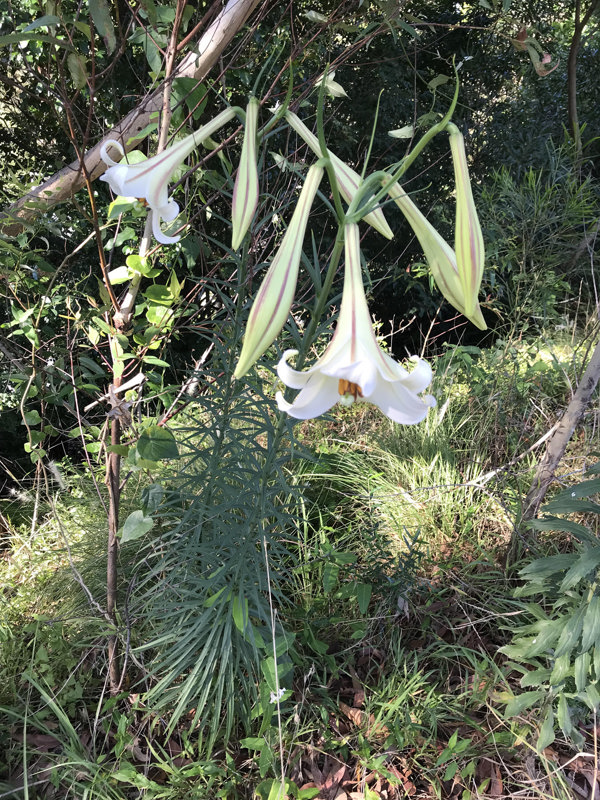
Formosan lily is a native of Taiwan. It was widely cultivated as a garden ornamental, particularly in the temperate regions of Australia. Unfortunately, it has become a major environmental weed. Formosan Lily grows along roadsides and in bushland, grasslands and disturbed sites. It spreads easily and can displace native vegetation.

Formosan lily is an upright herbaceous plant with unbranched stems growing up to 2 m tall. Its elongated and narrow leaves are stalkless and hairless. It has very showy funnel-shaped flowers which have six large white 'petals'. These petals are usually flushed with mauve or reddish-purple on the outside. Its large capsules are cylindrical in shape.

Dispersal: Seeds and bulbs are spread by water, wind, humans, contaminated soil and in dumped garden waste.

Control of Formosan Lily is difficult. Hand dig the plant out, making sure all parts of the bulb are removed. Don’t just pull the plant up. The bulb is quite deep in the soil and all you’ll get is the stem with some roots (called stem roots). Treat before flowering. Bag all seeds (capsules). Follow-up treatment is required. Spraying with herbicide is generally ineffective.

More information:
Sydney Weeds Committee
Weeds of Australia

A closely related species is November lily (Lilium longiflorum). November lily has wider leaves and its flowers are pure white, with no sign of mauve/reddish-purple flush.

Formosan Lily 2

Grow Me Instead

Swamp lily - Crinum pedunculatum. This Australian native plant has rosettes of broad leaves and         
clusters of white, highly fragrant, flowers on 1m stems. Suits any soil, full sun or dappled shade and is 
mildly frost tolerant, it also grows well near ponds.


Grass flag - Libertia paniculata. Australian native which forms a grass like clump with masses of white flowers in spring, for moist, semi-shaded positions.


25 Tunnel Road, Helensburgh,
NSW 2508 Australia

 merilyn@helensburghlandcare.org.au

 0414 819 742

Stay Connected

Helensburgh & District Landcare Group acknowledges the traditional custodians of the land. We pay respect to Aboriginal Elders past, present and emerging, and extend that respect to other First Nations people. We value their deep and continued spiritual and cultural connections to the land, waters and seas.

Helensburgh & District Landcare Group Inc is a non-governmental community movement dedicated to preventing land degradation and achieving sustainable land management, primarily in the 2508 postcode.

ABN: 12 869 870 867

https://landcareaustralia.org.au

Our site is powered by Easy Brew, a product created by Code Brewery®.